For travel management companies and their corporate travel clients
One content source, not one portal per client.
A travel management company with five corporate travel clients in mining, energy or aid work has five client portals to log into, because the content those clients move people on, company aircraft, chartered vessels, ground transport and camps, is not in the GDS. The mid and back office that run the agency were built for one source. Most workflow else is handled by hand on both sides of the coin, and logging into an extra portal is never welcome, which keeps that content orphaned outside the managed programme.
UnityTrip can remove an extra portal from the agent's day. It publishes each client's bookings, changes, approvals, manifests and claims as data, so a mid and back office that can take one more content source receives company-aircraft travel the way it receives air and hotel. The TMC's workflow stays its own. The client's rules stay the client's, executed by the policy engine before the booking reaches the agency.
- No leakage for the corporate travel client. The travel that used to leak around the side, booked by phone and email and seen only when the invoice arrived, is in one record with the commercial travel.
- Clarity of payment for the TMC. Every business booking carries the client's claim number, the approval that says the TMC will be paid, before the booking is made.
- Happier travellers. One consistent, elegant workflow whether they book for themselves or through the agency.
What a TMC can sell with it
- A new kind of account. Mining, energy and aid organisations with their own aircraft and camps have travel their TMC cannot see. A TMC that can take the content source can offer the whole programme, commercial and company-operated, as one managed service.
- A cheaper service on the accounts you have. The agent matches a feed instead of re-keying from a client portal, so the cost per booking falls and the margin on the account rises.
- Self-service and offline without losing the account. Self-service and offline for travellers under the client's policy, with the agency handling the exceptions and keeping the relationship.
What a corporate travel client can ask its TMC for
- The whole fleet inside the managed programme. Company aircraft, vessels, ground transport and camps booked, approved and reported with the commercial travel, in one record.
- Improved service for travellers and support staff at less cost, with the same workflow for self-service and offline.
Self-service and offline added to a workforce operation from its TMC streamlines all sides. Treating it as a content source goes one layer deeper.
Two ways a TMC works with it
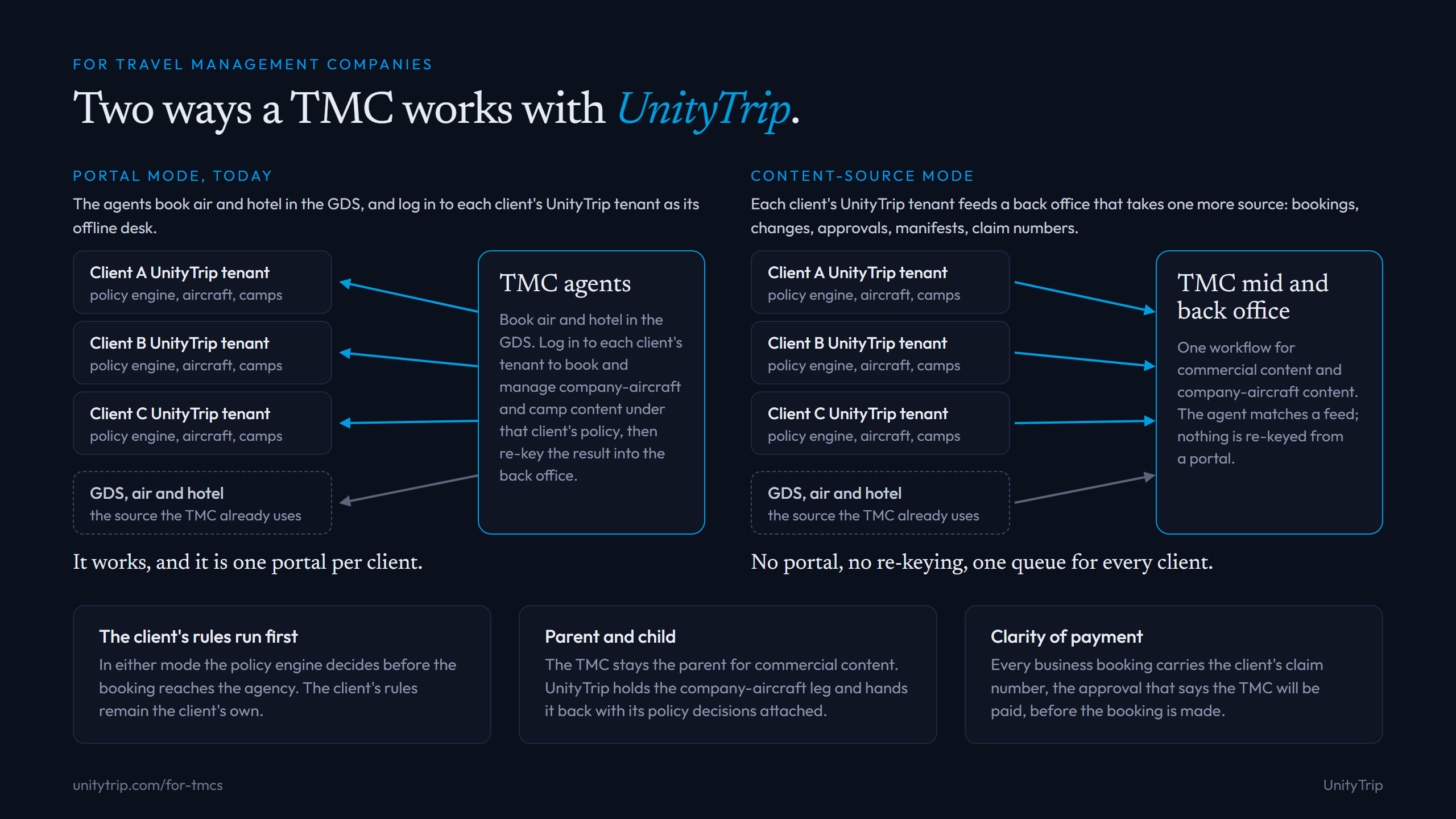
- Portal mode, today. The TMC's agents work inside the client's UnityTrip tenant as the client's offline desk, booking and managing company-aircraft and camp content under the client's policy. It works, and it is one portal per client.
- Content-source mode. The tenant feeds the TMC's own mid and back office. Bookings and changes arrive with their approvals, manifests and claim numbers and are matched into the same workflow that handles commercial content. No portal, no re-keying, one queue for every client.
The feed comes from the services the platform already runs on, booking, company rules, approvals and users, with a message bus for orchestration. Connecting them to a back office that can receive the content is days of work, not a project. The parent-and-child pattern underneath both modes is set out on the partners page: the TMC stays the parent for commercial content; UnityTrip holds the company-aircraft leg and hands it back with its policy decisions attached.
What the mid and back office needs
One more content source. Most mid and back offices take the GDS and run everything else with a little-understood lack of automation, which is why TMCs assume that where they are today is all that can be done. It is not. A back office built to accept several sources turns company-aircraft travel from a portal into a feed, and the agency's cost per booking falls with it.
Trans-End, founded by Louis van Zyl in Cape Town, is building exactly this: a mid and back office for travel management companies that takes content from many sources and makes the workflow easy, with its first customers arriving in 2027. Louis has worked at a senior level on both sides of the seam, travel management companies and enterprise ERP, and brought self-service to a workforce operation from the TMC side in an earlier decade. A TMC that wants to know more can be introduced; talk to us.
Common Questions
How does a travel management company win a mining, energy or aid account with this?
By offering the whole programme. Those organisations move people on company aircraft, chartered vessels, ground transport and camps that no TMC can book from the GDS, so that travel sits outside the managed programme today. A TMC whose mid and back office can take UnityTrip as a content source can offer commercial and company-operated travel as one managed service, with the client's own rules applied before a booking reaches the agency.
Can one travel management company serve several enterprise clients from one place?
Yes. Each client's UnityTrip tenant publishes its bookings, changes, approvals, manifests and claims as data, and a mid and back office that accepts an extra content source receives all of them in one workflow. The agent never opens a client portal. The portal remains available for TMCs that prefer to work inside it.
Does UnityTrip compete with TMCs?
No. UnityTrip supplies the content a TMC cannot book, allocated by the client's own policy. The TMC stays the parent for commercial content and keeps the client relationship. UnityTrip is a content source inside the TMC's service, not a rival to it.
What does our mid and back office need?
The ability to take one more content source alongside the GDS: a feed of bookings and changes with their approvals, manifests and claim numbers, matched into the same workflow that handles air and hotel. Most mid and back offices were built for one source and run the rest by hand. Where that is the case, the portal mode works today and the feed can follow when the back office can take it.
What should a corporate travel client ask its TMC for?
Company aircraft, vessels, ground transport and camps inside the managed programme, in one record with the commercial travel; the choice of booking for themselves or through the agency, under the same rules, because some travellers want self-service and others want a relationship; and a service that costs less because the agency is matching a feed rather than re-keying from a portal.
How many portals do your agents log into?
If the answer is one per client, the content is already there. Tell us which clients and which back office, and we will tell you what the feed would look like. If you are the corporate travel client, ask your TMC whether its back office can take one more source.