Your fleet.
Your rules.
One platform.
One booking, one PNR, one policy layer — posted to finance.
An engineering-led practice for companies that move people the way airlines move passengers: we read your record, diagnose with people who have run the operation, and act with a cloud-native platform built for it. We diagnose because we can treat.
The Real Problem
Normal travel software wasn't built for this.
Commercial booking tools book flights to a city. They have no concept of a leased aircraft, a company vessel or a private airfield. Your ops team fills the gap by hand: spreadsheets, phone calls, and people at counters.
Multiple transport modes, zero integration
Bookings live in three systems, itineraries in someone's inbox, costs across spreadsheets nobody trusts. Every trip is coordinated by hand.
The operations team already knows where it breaks
Double-bookings, seats released too late to refill, budget that leaks through channels no report sees. The record holds the answer; what is missing is someone reading it end to end.
A small airline inside a company
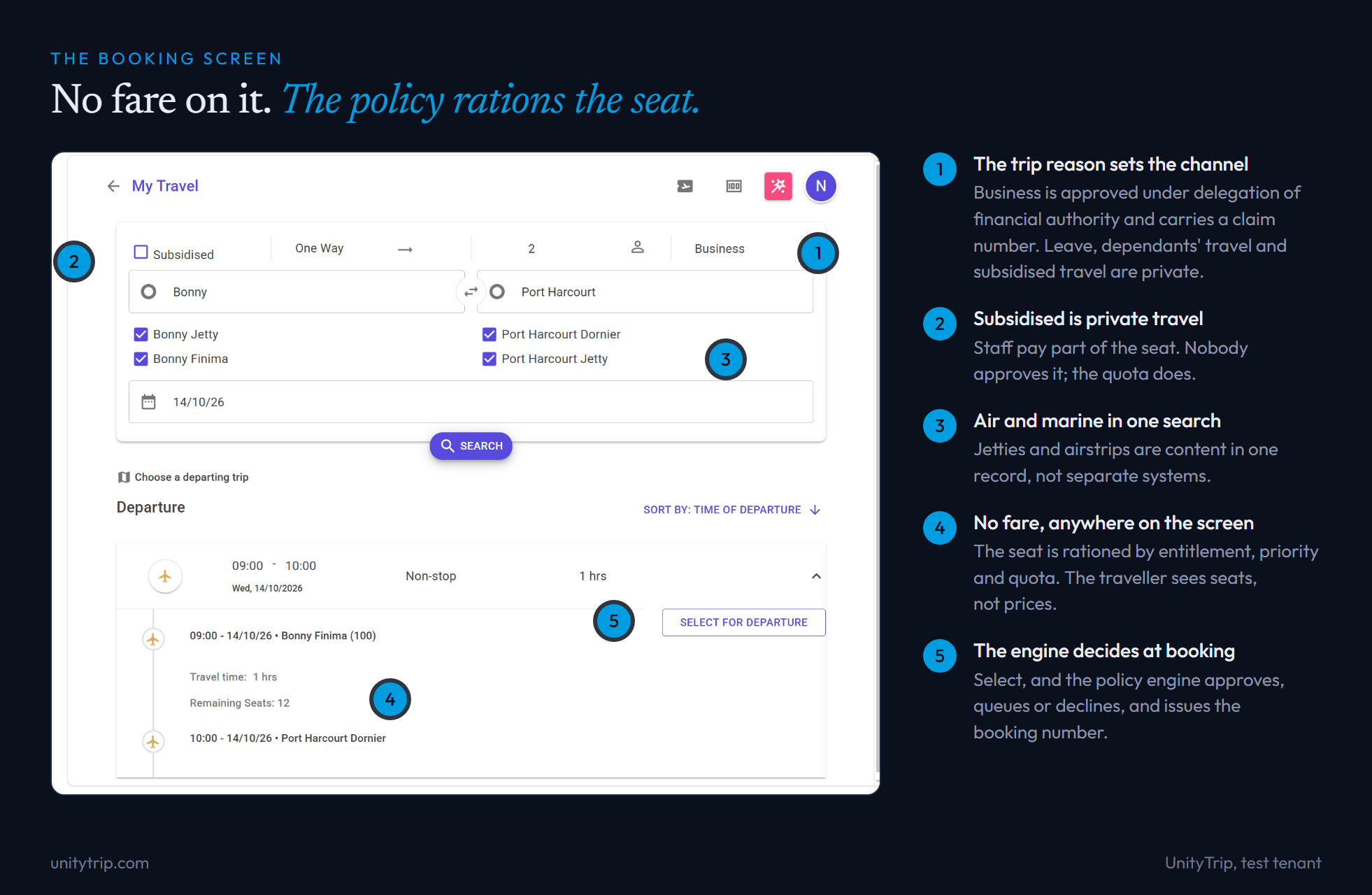
An organisation that operates its own transport has an airline's allocation problem and tools built for booking business class to a city. The seat has no fare, so nothing rations it, and tools that assume a fare have nothing to say.
Every empty seat is cost already committed
A leased aircraft that flies with empty seats because nobody could see the bookings in time is money already spent. It shows in the record before it shows in the accounts.
The Model
One canonical model of workforce movement.
Everything that can be checked without talking to us is on one page: what can be checked about UnityTrip.
UnityTrip doesn't model flights. It models movement: every leg, bed, rule, and approval in a worker's rotation as one operational journey. The interface is a projection of that model — each tenant configures its own ontology, and the engine executes it deterministically.
A Worker Movement
One Operational Journey
Every step governed by the same configured rules, recorded as events, auditable end to end.
Why the model comes first — and why travel is the first vertical: read the platform thesis →
The Architecture
Built as the integration hub,
not another silo.
UnityTrip is a horizontal portal that holds your organisation's travel rules in one place. Whatever transport content and systems you already run plug in beneath it — your existing relationships stay yours. Integrations in production include SAP (bidirectional), Thomalex for commercial flight content, and Elina PMS for accommodation — the full list is published, not promised.
See the full architecture →The Consequence
The result: fewer no-shows and more seats filled on capacity already paid for. The numbers, and where they come from, are on the benchmarks page. See how it works →
Free Tool — No Account Needed
Build a leased-travel policy — free, in your browser.
The Leased Travel Policy Builder turns priority, quotas, seat allocation, and booking windows into a structured policy a booking engine can execute.
About five minutes. Nothing uploaded. The same policy logic UnityTrip runs in production.
Get in Touch
Tell us how your company moves people.
If your company moves people across more than one transport mode, tell us how. If the question is where the money leaks, start with the operations review.
FAQ
Questions people ask before they call.
What is UnityTrip?
UnityTrip is a workforce aviation logistics platform for oil and gas, LNG, mining, and other field-heavy organisations that fly their own schedules on their own or leased aircraft — and for FIFO workforces, humanitarian and NGO deployments, and charter and marine operations. It is an engineering-led practice with its own cloud-native platform. It provides self-service booking for travellers and schedule management across travel groups, alongside commercial bookings, approvals, real-time spend visibility, expense processing and duty of care. It runs on Microsoft Azure and is sold through the Azure Marketplace.
What is workforce aviation logistics?
The discipline of moving a workforce on aircraft an organisation owns, leases or charters, alongside commercial flights. The category page defines it.
How do you allocate seats on company aircraft?
The seat has no fare, so entitlement rations it rather than price. A traveller's grade and policy group set what they are entitled to, a priority matrix decides who is displaced when a flight is oversubscribed, quotas limit how often a seat can be used, and go-show automation refills seats freed by no-shows. Published outcomes across UnityTrip tenants: leased-fleet seat utilisation lifted from a 40% industry average to 90%. Basis at benchmarks. How to write the rules: the seat allocation policy guide.
Can commercial and charter flights be booked together?
Yes. A commercial leg, a chartered or leased flight, a crew boat and ground transport can be booked as one multi-leg journey under one PNR and one policy engine, so the record, the approval and the cost allocation are one.
How does UnityTrip enforce travel policy?
UnityTrip includes a configurable policy engine that enforces travel policy at the point of booking — not after the fact. Rules reflect how each organisation actually operates: approval workflows, spend limits, preferred suppliers, booking windows and role-based permissions can all be configured without custom code.
Does UnityTrip integrate with HR, finance and ERP systems such as SAP?
Yes. UnityTrip connects to HR, finance and ERP systems via a change-feed pattern that avoids polling and tight coupling. Integrations in production include SAP (bidirectional: master data in over RFC, postings out through middleware), Thomalex for commercial flight content and Elina PMS for accommodation. SAP stays the system of record; UnityTrip runs travel above it. See UnityTrip and SAP S/4HANA.
Is UnityTrip available on the Microsoft Azure Marketplace?
Yes. UnityTrip is available on the Microsoft Azure Marketplace as a SaaS subscription, with a free trial. A purchase bills through the customer's existing Microsoft agreement and can count against a Microsoft Azure Consumption Commitment (MACC). It is hosted on Microsoft Azure.
Who founded UnityTrip?
UnityTrip was co-founded by Neil Middleton (Co-founder and CEO), who spent eighteen years founding and running the previous generation of regional-airline operational software before exiting in 2018; Benjamin Kappel (Co-founder and Principal Architect), who designed its distributed, event-sourced architecture; and Dr Cindy de Villiers (Co-founder, Business Development and Investor Relations). More on the About page.
Why does UnityTrip publish no named customers, and how can its figures be validated?
The numbers are real; the customer is confidential. The 90% figure is a measured production result from energy and resources operations, averaged across deployments and years, not a model or a theoretical case study; the 40% baseline is the industry average for comparable small-fleet flying. UnityTrip does not name customers, because the organisations that run it operate under strict contractual confidentiality and the underlying customer and fleet data stay with them. Two things support the figures without naming the customer. The 40% baseline sits inside what the FAA reports for comparable small-fleet flying: Part 135 commuter carriers averaged a 51% passenger load factor in the year to June 2023, and on-demand multi-engine turboprops and mid-size jets fly 37–43% of seats occupied (FAA, Economic Values, Section 3). One energy operator shows the gain in another form: its fleet halved while demand and traveller satisfaction rose. What is public is the outcome, the methodology, and the benchmark basis; what is private is the customer data, the fleet data, and the validation, which an evaluating organisation can review under a confidentiality agreement during due diligence. Everything that can be checked is listed on one page: what can be checked about UnityTrip.
Operations teams ask how good the UX is, how fast change ships, what happens when upstream data is wrong and what an outage would break: questions from operations teams. Finance teams ask what happens when staff pay for a seat and then cancel: the cancellations and refunds guide sets out who owes what.